Skip to content

How to calculate π

How would you calculate \pi? I remember being sent as a boy of ten into the schoolyard to find circular objects to measure. Our attempts to wrap a tape around a dustbin lid clearly did not represent the optimal method.

Perhaps you know a few digits of \pi. Starting from scratch, how would you find more? We know \pi is irrational, so it cannot be expressed as the ratio of two numbers. Worse, \pi is transcendental, so it is not the solution of any polynomial equation with integer coefficients.

There is a passage of the Bible (1 Kings 7:23) which refers to “a molten sea” which is “ten cubits from the one brim to the other” and “a line of thirty cubits did compass it about”. This figure of \pi=3 did not represent the state of the art, with more accurate values being recorded much earlier in Egypt and Mesopotamia.

A famous approximation is attributed to Archimedes (287-212 BC), who worked using only geometric methods. Archimedes took a circle and inscribed within it a polygon. The perimeter of the polygon, which is contained within the circle, is smaller than the circumference of the circle itself. Then he superscribed a polygon outside the circle. The perimeter of this second, larger polygon is larger than the circumference of the circle itself. If you think about increasing the number of sides on a polygon you will notice that the more sides a polygon has, the closer it gets to the shape of a circle. By increasing the number of sides on his two polygons and considering their perimeters, Archimedes could define two series, one increasing and one decreasing, both of which have \pi in their limit.

Archimedes took this as far as polygons of 96 sides and came up with an upper limit for \pi of \frac{22}{7} \approx 3.142857 and a lower limit of \frac{223}{71} \approx 3.140845. Because these coincide in the first three digits, we can conclude that \pi begins 3.14 \ldots

Others, following the method of Archimedes or developing it independently, extended to polygons with greater numbers of sides. This method culminated with Ludolph Van Ceulen who, around 1600, produced an approximation for \pi to 35 decimal places. Those 35 digits were inscribed on Van Ceulen’s tombstone.

More modern approximations involve calculating the terms of an infinite series involving \pi, which can be rearranged to find an approximation for \pi. For example, the following was discovered by James Gregory:

\frac{\pi}{4}=1-\frac{1}{3}+\frac{1}{5}-\frac{1}{7}+ \ldots

Using such a formula, one can generate \pi to as many decimal places as necessary by taking more terms. However, this series converges very slowly. For example, 10,000 terms are needed to get just four decimal places. John Machin found a series that converges much more quickly to \frac{\pi}{4}:

\frac{\pi}{4}=\arctan{\frac{1}{5}}-\arctan{\frac{1}{239}}

which uses a more general James Gregory result:

\arctan{x}=x-\frac{x^3}{3}+\frac{x^5}{5}- \ldots (-1\leq x \leq 1)

Machin used this formula to calculate one hundred digits of \pi in 1706, the year William Jones introduced the modern use of the Greek letter π.

Computers enter the story in 1947 when D. F. Ferguson of the Royal Naval College in England calculated \pi to 710 digits with a desk calculator. In 1950 George W. Reitwiesner published more than 2000 digits of \pi in the journal Mathematics of Computation. These digits were calculated on the ENIAC computer at the suggestion of John von Neumann, who was interested to obtain a statistical measure of the randomness of the distribution of the digits (whether digits occur equally often in \pi remains an open question).  Reitwiesner and his team used the same formula as Machin and ran ENIAC for around 70 hours, including the time taken to handle the punch cards.

More recently, series are used which operate on similar principles but converge even more quickly. The latest computer record used the 1989 Chudnovsky algorithm, which is based on the series:

\frac{1}{\pi} = 12 \sum^\infty_{k=0} \frac{(-1)^k (6k)! (13591409 + 545140134k)}{(3k)!(k!)^3 640320^{3k + 3/2}}.\!

In 2011 Shigeru Kondo set this record on a custom-built home computer using y-cruncher, a program written by Alexander Yee, to calculate \pi to ten trillion digits.

The True Importance of Friends

Why your friends have more friends than you do. That is the rather provocative title of a 1991 paper by Purdue University sociologist Scott Feld. While the title is rather provocative, thankfully it turns out that the statement is built on a solid foundation.

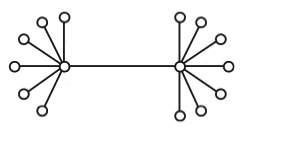
It turns out that your friends having more friends than you do is a consequence of the fundamental structure of networks. It comes down to the difference between the average number of friends that any node in a network has versus the average number of friends of friends. Think of a party where the host invites 20 people, none of who know each other. The network that represents that party would look like one node in the center with 20 lines connecting it to otherwise unconnected nodes all around it. Now if you were to look at the average number of friends for any node in this network you have 20 nodes that have exactly 1 friend and one node that has exactly 20 friends, so you end up with an average of 40/21. So the average number of friends is just under two friends per node. Now the number of friends of friends is counted a bit differently. First you count the total number of friends of friends. In this cases all 21 nodes have a friends of friends number of 20. and therefore there are a total of 420 friends of friends in the network. Then you have to take that number of friends of friends and divide it by the total number of friendships in the network, which was reckoned above to be 40. This gives us an average number of friends of friends of 10.5, which is rather larger than the average number of friends. This is simply down to the host being counted 20 times in the friends of friends calculation, versus all of the guests only being counted once. It is similar in all networks, where the nodes with more connections are counted more often when figuring out the average number of friends of friends.

Of course being about averages there are always individuals in a network that really do have more friends than their friends do, but they are in the minority. So, it really does turn out that most of us have fewer friends than our friends do. Feld thought that this was important, and saw it as being related to a lot of other sociological phenomenon, specifically something that he and a collaborator, Bernard Grofman, called the “class size paradox”. The class size paradox is a known sociological phenomenon that observes that individual students at a college tend to experience an average class size that is larger than the actual average at the college. Feld had this conclusion about this research:

The tendency for most people to have fewer friends than their friends
have is one sociologically significant class size paradox. Individuals who
find themselves associated with people with more friends than they have
may conclude that they themselves are below average and somehow inad-
equate. The analysis presented in this paper indicates that most individu-
als have friends who  have more friends than average and so provide an
unfair basis  for  comparison.  Understanding the  nature of  a  class size
paradox should help people to understand that their position is relatively
much better than their personal experiences have led them to believe.

This would have all probably stayed in the world of sociology, if Harvard’s Nicolas Christakis had not taken a look at Feld’s work and seen that it could have a very different application.

Nicolas Christakis is a physician and social scientist who, along with UCSD’s James Fowler, uses the tools of social network theory and sociology to help solve health problems. In a talk to TED in Cannes, France Christakis spoke about a new application of people’s friends having more friends than they do. He had been working on using social networks to help predict the spread and outbreak of epidemics, but he had been running into a problem. In Christakis’s own words, ‘The problem, however, is that mapping human social networks is not always possible. It can be expensive, not feasible, unethical, or, frankly, just not possible to do such a thing. So, how can we figure out who the central people are in a network without actually mapping the network?’ This is where Feld’s research comes in. Since Christakis was looking to help predict the spread and outbreak of epidemics he needed to be able to observe the most central and important nodes in a network. He knew that while random choice of people would not be the most useful tactic to use; perhaps if he took his random choices and asked them to nominate a friend they would be more central because, as he knew, they were likely to have more friends than his original choice. This idea would turn out to be rather potent.

Christakis used this method of friend nomination to study the spread of the swine flu, H1N1, through a population of Harvard students in 2009. He followed the people he had randomly chosen and the friends that they had nominated and within the friends group he received data that pointed towards an impending outbreak 46 days before the same indication of an outbreak appeared in the data from the randomly chosen group. That is a month and a half earlier warning of an epidemic, which could really help battle the spread of disease in the future. This is not just tied to epidemic research either, as a marketer could use this to help predict what trends will become hot before their competition has any idea or a pollster could see which presidential candidate is picking up steam before their campaign even has any idea. Christakis does say that the amount of notice that one would get from using this method would vary, but it turns out that Feld’s provocatively named paper is a more useful tool than Feld ever could have imagined.

Why the hot light bulb annoys me

The light bulb puzzle presents you with three switches, one of which controls a light bulb inside a closed room. You are permitted to flip switches as much as you like, then you must open the door and say which switch controls the light bulb.

You don’t seem to have enough information. You can flip one switch and open the door. If the light is on then you have found your switch. However, if the light is off you can’t tell which of the other two switches controls the bulb.

The solution is to first flip a switch on for ten minutes, then off again. Now flip a second switch on and open the door. Leaving the light bulb on for ten minutes would allow it to heat up. Then, if the light is on or off and hot, you know which of these two switches was the cause. If the bulb is off and cold, you can identify the third switch.

This puzzle annoys me, but I was not sure why.

I heard the following as a “grammar test”: which is correct, “the yolk of an egg is white” or “the yolk of an egg are white”? The answer was given as: “don’t be silly, the yolk of an egg is yellow”. This annoyed me because it was set up as a grammar test so I took the incorrect yolk colour to be a mistake in the statement of the problem that was safe to ignore, restraining myself to the grammatical aspect.

Here is another puzzle, a sorites. Sorites were included by Lewis Carroll in his book Symbolic Logic (1897). Your task is to arrange the following logical statements into a chain to draw a conclusion.

  1. babies are illogical;
  2. illogical persons are despised;
  3. no one is despised who can manage a crocodile.

In this case, since babies are illogical, illogical persons are despised and despised people cannot manage crocodiles, we conclude: “babies cannot manage crocodiles”.

I have presented this to someone who said that the result is obvious since of course a baby cannot manage a crocodile. However, there is no requirement for the statements in a sorites to be true. Are illogical persons, including babies, really despised? This is a logic puzzle in which the question of whether a baby could manage a crocodile in reality is not relevant.

For me, saying “don’t be silly, the yolk is yellow” is like saying “of course babies can’t manage crocodiles”. You have been placed in the constrained reality of the puzzle and it is irritating to allow extra information from outside of the puzzle. In the light bulb puzzle we have switches that cause lights to illuminate. The fact they also cause the bulb to heat up is a fact from the real world intruding on the world of the puzzle. You might equally well say “flip each of the switches and look at the crack under the door to see if any light comes out” or “why are there three switches, anyway?”

Is there a way to fix the puzzle to remove the irritation? Mentioning in the statement of the puzzle that the bulbs heat up would give the game away, while not mentioning it situates the solution outside the constrained reality of the puzzle. Consequently, this cannot work as a viable puzzle.

That is why the hot light bulb annoys me.

Early Morning Mathematics

A blinking light was truly a sign of a good night’s sleep. Swinging his legs off the bed Lee spoke to no one, “REM Scanner results.”

From speakers hidden somewhere out of sight came the answer, “Two probable, three potentials, and one solution.”

“Bring them up on the table. While you are at it, get me a bowl of cereal and a 3 cup brew at the 2.2 ratio,” requests Lee as he walks into his bathroom. Quick cleansing blast and face splash later, Lee emerges and strides to sit down at his table. Ignoring the cereal bowl and coffee carafe he immediately starts waving his hands over the display embedded in the surface.

“A couple of these probables look oddly familiar, have you done your job and scanned through Polymath and Overflow DBs for duplicates?”

“Yes.”

“And?”

“The solution is new, but for a problem that already has solutions listed at Algebra Overflow. None of the potentials or probables tripped the filters. Would you like me to do a full depth search over all theorem DBs?”

“Hold off for now. Get the new solution added to the Algebra Overflow problem posting. While you are at it these probables look eminently provable, so send them through the Theorem Prover. If you get positive results that is when you do the full search and check for uniqueness.” Finally taking a spoonful of cereal from bowl to mouth, Lee’s brow starts to crinkle in a way that only happens when he sees something interesting, or smells something disgusting. “Wait. Drop everything. Give me a priority search that second potential, it might just be the real thing.”

Two refills of the coffee cup later the voice interrupts Lee’s perusal of his morning news feeds, “Search came back negative, no similar result is, or has been, talked about on any of the normal channels.”

Smile growing on his lips Lee leans back, “Good. Code it up, Polymath Standard, and get that potential public and be sure to raise its important flag as high as you damn well can. This is one that the community will like, I can feel it. In fact, bring up the workspace, I am going to have some fun with it myself.” News feeds replaced with blank white space, Lee’s crinkly brow comes back as he fills the display with group theory.

Fundamental principle behind many dynamical systems verified

Diffusion is a physical process that is an essential component of innumerable phenomena in nature, including when your lungs transfer oxygen into and carbon dioxide out of your blood. Now a fundamental principle behind diffusion has at last been experimentally verified.

An ergodic dynamical system is one for which the average behaviour of a single component over time is the same as the average for all components at a single time. This allows researchers to assume for some systems that measurement of a given variable on one particle – such as the distance covered by a particle in a given time interval – should yield the same average value as a single measurement of the same variable on a collection of particles, so that each particle behaves as a small version of the system as a whole.

It is generally accepted that the ergodic hypothesis is applicable to the dynamics of diffusive processes. Diffusion describes the spread of particles through random motion under the influence of thermal energy. In virtually all chemical reactions, diffusion is responsible for bringing reactants sufficiently close together to enable them to react.

However, as Professor Jörg Kärger at Leipzig University points out, “although diffusive processes have been investigated for the past 150 years, the principle of ergodicity has not yet been experimentally verified”. This is because so far it has only been possible to quantify diffusive processes by measuring many particles simultaneously.

A collaborative effort by Professor Kärger’s group at Leipzig University and Professor Christoph Bräuchle’s team at LMU Munich looked to measure the diffusive behaviour of a system of particles and the trajectories of single molecules in the same system. The LMU researchers were able to track individual molecules, while the Leipzig group could study the collective behaviour of the whole system.

The problem for the teams to overcome was that successful application of the two methods requires apparently conflicting conditions. The Leipzig group’s method needed high concentrations of molecules with large diffusion coefficients, while the LMU team’s method works best with extremely dilute solutions of species with small diffusion coefficients.

Using particular organic dyes with high fluorescence yields in combination with porous silicate glasses containing networks of nanometer-sized channels in which the dye molecules can diffuse, the researchers were able to create a system on which both techniques could be performed.

Comparing data, the two teams found that the diffusion coefficients obtained by the two techniques agreed with each other, providing the first experimental confirmation of the ergodic hypothesis in this context.

This work is important because sometimes a mathematical theory can make accurate predictions about the real world up to a point but not actually reflect the real world context. A nice example is from cosmology in the late 16th Century, when mathematical models of the universe with the Earth or the Sun at the centre both produced viable predictions of astronomical events like eclipses. Further experimental data was needed to demonstrate that one reflected physical reality more accurately than the other. In this way, experimental checking of fundamental principles, such as the current work at the Large Hadron Collider, is important whether or not it backs current theory.

The next step for this research will be to look at systems that do not conform to the ergodic principle and determine the reasons for this. “The diffusion of nanoparticles in cells looks like an interesting example,” says Bräuchle, “and for us the important thing is to find out why the ergodic theorem doesn’t hold in this case.”


Notes:
Based on press release: ‘Glowing beacons reveal hidden order in dynamical systems – Experimental confirmation of a fundamental physical theorem‘, 19 October 2011, Ludwig-Maximilians-Universitaet Muenchen (LMU).
Research published as Feil, F., Naumov, S., Michaelis, J., Valiullin, R., Enke, D., Kärger, J. and Bräuchle, C. (2011), Single-Particle and Ensemble Diffusivities—Test of Ergodicity. Angewandte Chemie.

The Patent World Order

From the Offices of:

Lee Stickem,

Elisabeth Tooya,

And Tyler Howe

Esquires


Dear Professor Geoffrey Strickland,

It has come to our attention that you have submitted a paper to the Journal of Amazing Mathematicsentitled “A Simple and Concise Proof of Goldbach’s June 30th, 1742 Conjecture”, which we are going to kindly ask that you withdraw due to copious infringement of the patents held by our client, Consolidated Venture Solutions Inc., herein referred to as CVSI. As we are sure that you are aware the Court of Appeals for the Federal Circuit on Aug, 16 2011 decided the case Cybersource Corp. V. Retail Decisions, Inc., which set the precedent that if the Mathematics is sufficiently hard then it is patentable. After which, and pursuant to, our client CVSI acquired the patents to many Theorems, Corollaries, and Lemmas, of which you find yourself in violation of no less than five.

The process through which these infringements are determined are as simple as they are effective. First your paper was converted to a machine readable format, then it was fed into an automated proof checker, this proof checker then analyses all of your steps for validity and determines which prior results are needed to justify the previous step, and finally these results are checked against our database of patents. This is the same process that the Federal Government uses when verifying the foundations of governmentally funded work. The five major violations, and there were many minor violations that we are simply not going to pursue at this point in time, were:

1. Line 34, Page 6 “It clearly follows that …”

In fact it is not clear, it actually uses the result, “If the primes between n and n+1 are sufficiently spectral then…” as proven by J.L. Discher and I.K. Remmington in their paper “Primes and Their Auras” in Ars Arithmancy 44

2. Line 2, Page 13 “We can therefore claim the following…”

You can claim what follows but only if you take into account that, “For any given collection of numbers we have shown that the following are true…” shown by E.O. Dann in “Numerical Groupings as Determined by Scaling Large Cardinality” published in Journal of the National Academies of the Royal Society of Lichtenstein 274(5)

3. Line 45, Page 13 “Now assume that this is true for n and…”

In fact you do not have to assume it is true as “The following is true for all integers…” was determined by Q.W. Sullivan, W.P. Lee, and A.A. Paint in the seminal paper “Numerous True Theorems about the Integers” published as a supplement to the New York Mathematical Association’s A Stupendously Huge Collection of Things about Integers that are True

4. Line 22, Page 15 “Since even integers can be written as…”

You can write all even integers as such, but only by using “This shows that all even integers can be written as…” elucidated so clearly in Y.E. Granner and C.X. Xon’s, “The Impact of Repeated Enhancement on Non-Transcendental Numbers” from TheMathematical Consequences of Procedurals 97

5. Line 37, Page 17 “With this I have proven the Goldbach Conjecture.”

In fact you will find that in many previous court decisions the person who first writes down a theory is given priority in patent fights and therefore you can not claim priority on the Goldbach Conjecture, as Goldbach’s claim is more than two centuries before yours. As CVSI owns the collected work of Goldbach they thereby own the Conjecture.

     We, of course, would have no issue helping you and CVSI reach an agreement over licensing the patents that you infringed, and such an action would allow you to publish your paper without the spectre of future legal issues. In fact, CVSI has even indicated that they would be willing to give you a share of the residuals that will, without doubt, be derived from Goldbach Conjecture licensing, in respect to the quality of work displayed in your paper. If you do decide to go forward with the publication of this paper without licensing though, we will immediately file a lawsuit that we will win and you will not see a cent.

We hope that you make the right decision, and that you and CVSI can reach a mutually beneficial agreement that will allow you to continue contributing such important work to mathematics,


Reginald Leach, Esq.

Hardy’s Apology: what’s to dislike?

In recent years I’ve felt quite glad I never read G.H. Hardy’s massively influential book A Mathematician’s Apology (1940). I’d heard of this by the time I arrived at university but never got around to borrowing the copy I saw in the Hall library. Recently I decided to take a look and found much to dislike.

First, there’s his view of public communication of mathematics. Sometimes it seems all advice on public engagement starts with a quote from the Apology; as though a mathematician must acknowledge, like Hardy in his introduction, the improper nature of their endeavour.

I remember being told by an established communicator of mathematics about the importance of maintaining a strong research record to quell critics who might accuse him of undertaking public engagement work only because he has ‘lost his touch’ for research. In the introduction to the Apology, Hardy says that writing about mathematics,

is a confession of weakness, for which I may rightly be scorned or pitied by younger and more vigorous mathematicians. I write about mathematics because… I have no longer the freshness of mind, the energy, or the patience to carry on effectively with my proper job.

You may be aware that this blog takes its name from the Apology‘s opening paragraph. Hardy regards communication of mathematics as work for ‘Second-Rate Minds‘. We quote Hardy with irony, because we do not agree with him.

I believe there is great importance in communicating mathematics as widely as possible. I think it is important that children are encouraged to enjoy mathematics so that they might take further interest in the subject. Equally important is the view of mathematics held by the general public. Despite Hardy’s disdain for applications, mathematics nevertheless pervades the modern world and benefits from society valuing its role.

I feel sorry that a passionate and able communicator may not be valued by mathematicians, and that such abilities might be tempered by concerns about the scorn of one’s fellows. I happily accept that outreach is not for everyone; indeed society will benefit more from most mathematicians getting on with their research. Still, I don’t think we should look on those with a passion for communicating their subject as having failed.

I’ve chosen to pick on Hardy for his views on public communication of mathematics, though there’s much else I find fault with in his Apology. He expresses several opinions which are these days widely held and which I dislike.

Hardy is a proponent of the unfortunate cult of youth, writing, “if a man of mature age loses interest in and abandons mathematics, the loss is not likely to be very serious either for mathematics or himself”. Hardy hates teaching, although loves lecturing to “extremely able classes”.

Perhaps most famously, there’s his view on the “utility” of mathematics. It is easy to pick on a number theorist writing in strong terms against mathematics that can be applied to the real world, particularly to the business of war, at a time when modern cryptography was being nurtured at Bletchley Park. I have seen people take this argument to an extreme, somewhat unfairly since Hardy also writes against the “misconception” that “pure mathematicians glory in the uselessness of their work, and make it a boast that it has no practical applications”.

Having criticised these views, there is much in the Apology that is thought provoking and it is certainly worth a read. I like some of what Hardy says about the nature of mathematics and there is an interesting and frank account of what led him to the subject as a boy. Still, I am not sad that I missed reading the book in a more formative state of my development.


Afterword: Although I didn’t realise it at the time I sent the first draft of this text to Samuel for editing the morning after Sarah Shepherd died. A few days later when I received Samuel’s comments I had heard the news. I haven’t changed the substance of the piece since then, just tidied up a couple of useful points Samuel made about the flow and grammar of what I had written, yet the topic is curiously close to my involvement with Sarah’s work. I think Sarah would have agreed about the importance of promoting mathematics and the place of applied mathematics. She wrote passionately about the value of mathematics applied to the real world and the importance of communicating this to children and the general public. Through her iSquared Magazine she encouraged many young researchers to take their first steps in public engagement by writing about their research area for a popular audience. Consequently I dedicate this essay to Sarah Shepherd.

Let’s Make These Graphs Magic

One does not often use the term magic when referring to a mathematical idea. Proof, theorem, unequivocal truth all come up much more often. The one case that many people will be acquainted with are Magic Squares. Magic Squares are square arrays of integers such that all of the rows, columns, and diagonals sum to the same integer. I on the other hand am much more interested in a different, albeit similar, type of Magic; the magic of certain types of edge labelings of graphs.

The graphs I refer to are not the lines and parabolas of middle school algebra, nor are they the stock price plots and histograms from newspapers. These graphs are a much more abstract concept derived from the work of the great Swiss mathematician Leonhard Euler, of vertices that are connected together by edges. This has turned out to be an incredibly powerful tool in mathematics that has led to major results which include, but in no way are limited to, that four is the maximum number of colors needed to fill in a map so no two bordering countries are the same color and a more effective method for the prediction of just when a disease, such as the swine flu, is going to reach epidemic status. An edge labeling of one of these graphs is exactly what it sounds like, placing labels on the edges of these graphs. The specific type of labeling here requires all the labels to be integers that are not 0. After a graph has an edge labeling it is then possible to create a vertex labeling by summing together all of the labels of the edges that connect to a vertex.

Graph with Edge labeling


Graph with Vertex Labeling

If this vertex labeling is constant, the same for all vertices, then it is said that edge labeling is magic.


Graph with a magic edge labeling

Before I go any deeper into a discussion of this please determine a magic labeling for the following two graphs.


Graph 1


 Graph 2

 For a mathematician just finding a couple of these magic-labelings would be fun but ultimately not very interesting, so let us start to restrict ourselves. Let us begin by only labeling the edges of our graphs with positive integers that are less than some integer n. Once there are labels on the edges the next step is to find the vertex labels and here in is the second restriction, addition modulo n. Modular addition, written as a+b mod n, is equal to the remainder of a+b when it is divided by n. Take for example 4+3 mod 2. This is equal to 1, since 1 is the remainder when 7 is divided by two.  In a similar way 4+2 mod 3 equals 0, can you see why? If we try to label with these restrictions we could just maybe, begin to see patterns.

In fact, mathematicians refer to all of the integers n such that there is magic labeling under this restriction as the integer-magic spectrum of the graph. Some graphs have integer-magic spectrums that contain all of the positive integers, such as Graph 1. Others have more limited integer-magic spectrums, Graph 2 is a good example as its integer-magic spectrum is all of the even numbers greater than 2. Then you have examples, like the graph below, which allows no magic labeling, or in other words is just not magic.


                 Non-Magic Graph


In order to have even more fun some mathematicians, one who even looks very remarkably like myself, have asked the following question: Which members of the integer-magic spectrum of a graph allow a vertex labeling of 0. If there is such a zero magic-labeling then it is said that n is in the null-set of the integer-magic spectrum of the graph. I happen to know the null sets for the graphs pictured above, can you find them?


Moving on a strange diagonal

4 by 4 grid of dots

The puzzle grid

Here is a puzzle I enjoy giving to students. Given a 4×4 grid of sixteen dots, draw six straight lines that form a continuous path passing through all of the dots. Here, continuous means you must be able to draw over your six lines in one go without taking your pen off the paper.
This task is easy to complete with seven lines and impossible with five. Six is where the interesting puzzle lies.
I have given this to undergraduate students up and down the UK, and I have noticed a common response that makes me enjoy this puzzle and the lesson it teaches.
Many students start playing with the puzzle, drawing lines on grids right away. This is good because playing is how you start to understand puzzles and by showing their thought processes I can look out for when they have misunderstood the problem. In my experience, this is a problem often misunderstood.
One approach I see quite often is to draw lines within the grid always moving to the next adjacent dot – either up, down, left, right or diagonally. I ask the student, why aren’t you drawing outside the grid? “What,” the student typically replies, “you’re allowed to go outside the grid?”

two lines indicated moving outside of the dots

Going outside of the grid on a strange diagonal

Then I ask, why are you only moving to adjacent dots, why not move at strange diagonals and jump around the grid in a more irregular fashion? Again, the response: “is that allowed?”
The statement of the problem was: “draw six straight lines that form a continuous path passing through all of the dots”. This says nothing to limit how you can move through the dots or where on the page you can draw your lines.
In fact, I know of fourteen solutions to this problem and each of them involves a strange diagonal and leaving the confines of the grid. By imagining these additional conditions the student creates a new problem – one that cannot be solved.
Good puzzles lie on a thin line between easy and impossible, and the particular wording in the statement of the problem is likely to be very carefully chosen to give you enough to solve it without being too easy. A would-be puzzle solver must check the wording to be sure they are attempting the puzzle that has actually been set and not some imagined, impossible version.